
Articles
/General
Explore the differences between Venturi flumes and weirs for open channel flow measurement, focusing on their operating principles, suitability, and maintenance.
3 min read
Advertisement
Table of Contents
This article explores the advantages and disadvantages of using a Venturi flume for flow measurement. We’ll delve into what a Venturi flume is, its key characteristics, and how it stacks up against other flow measurement methods like weirs.
A Venturi flume is a type of open channel flow meter that utilizes a constriction to create a critical flow. This constriction causes a drop in the hydraulic grade line, leading to the formation of a critical depth. They offer certain advantages over weirs due to the creation of critical depth through a horizontal constriction.
Venturi flumes are typically employed for measuring very large flow rates, often in the millions of cubic units. Unlike Venturi meters which measure in millimeters, Venturi flumes measure in meters. Discharge measurement involves taking two readings: one at the upstream location and another at the throat (the narrowest part of the flume).
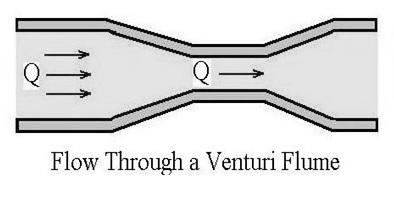
The free flow discharge formula is defined as:
$$ Q = C * H^n $$
here -
In conclusion, Venturi flumes are a valuable tool for measuring large flow rates, particularly in wastewater and open channel applications. While they offer several advantages over weirs, such as lower head loss and suitability for unclean water, their limitations, such as nonlinear flow and potential for plugging, should be considered during the selection process.
Advertisement
Related Posts
Articles
/General
Explore the differences between Venturi flumes and weirs for open channel flow measurement, focusing on their operating principles, suitability, and maintenance.
Terminology
/General
Explore the distinctions between Venturi flumes and Venturi meters, focusing on their design, applications, and measurement characteristics.
Terminology
/General
Explore the pros and cons of weirs for flow management and measurement. Learn about their applications, design, and limitations.
Advertisement