
Articles
/Electronics
This article explores the advantages and disadvantages of analog multimeters, highlighting their benefits and drawbacks for various applications.
2 min read
Advertisement
Table of Contents
Multimeters are essential tools for anyone working with electronics, and they come in two primary types: analog and digital. This article will compare and contrast these two types, highlighting their differences and respective strengths.
As depicted in Figure 1, an analog multimeter uses a needle that moves across a calibrated scale to display measurements. These measurements can include voltage (V), current (I), or resistance (R), and the device must be set appropriately for either AC or DC sources.
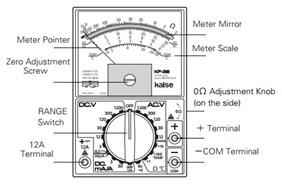
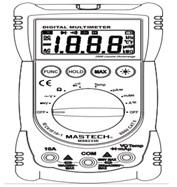
Figure 2 shows a typical digital multimeter, which features an LCD display panel and a rotating knob for selecting measurement types. Digital multimeters display readings as numerical values on the LCD screen. They use a variety of techniques to measure AC/DC voltage, resistance, and current, often without the need for manual range settings.
| Feature | Analog Multimeter | Digital Multimeter |
|---|---|---|
| Display Type | Analog with a metal pointer on a calibrated scale | Digital numerical display on an LCD screen |
| Measurement Output | Analog form using a needle | Digital form using numerical digits |
| Measurable Parameters | Current, voltage, resistance | Current, voltage, resistance, and impedance |
| Display Complexity | Simple scale markings for different measurement ranges | LCD display showing numerical readings |
| A/D Converter | Does not require an Analog-to-Digital Converter | Requires an ADC to convert analog signals to digital |
| Measurement Accuracy | Lower accuracy | Higher accuracy |
| Input Resistance | Varies depending on the measurement range | Constant across all measurement ranges |
| AC Frequency Limit | Lower maximum AC frequency that can be measured | Higher maximum AC frequency that can be measured |
Advertisement
Related Posts
Articles
/Electronics
This article explores the advantages and disadvantages of analog multimeters, highlighting their benefits and drawbacks for various applications.
Articles
/General
This article compares analog and digital instruments, detailing their key features, differences, and examples.
Terminology
/General
Explore the benefits and drawbacks of digital multimeters (DMMs), essential tools for measuring voltage, current, and resistance in electronics.
Articles
/Electronics
Explore the differences between clamp meters and digital multimeters, focusing on their unique capabilities and applications in electrical measurements.
Advertisement
Articles
/General
Explore the fundamental differences between analog and digital oscilloscopes, focusing on their operational principles and display methods.
Equipments
/Electrical
An overview of digital clamp meters, highlighting their features, benefits, and differences from analog clamp meters. Includes example features of a Meco model.