
Articles
/Electronics
Explore the differences between clamp meters and digital multimeters, focusing on their unique capabilities and applications in electrical measurements.
2 min read
Advertisement
Table of Contents
This article explores the advantages and disadvantages of analog multimeters. We’ll delve into their benefits and drawbacks, providing a clear understanding of where these devices shine and where they fall short.
Multimeters are essential tools for anyone working with electronics or electricity. They come in two main flavors: analog and digital. These devices allow us to measure fundamental electrical parameters like voltage, current, and resistance.
Think of electricity flowing through a wire like water flowing through a pipe. Just as water has pressure pushing it, electrical circuits have voltage. This voltage drives the flow of electrical current. Any opposition to this flow is what we call resistance.
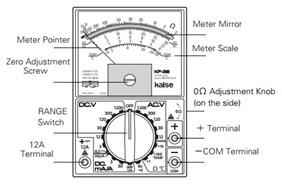 Image: Analog Multimeter
Voltage (V) is measured in volts, current (I) in amps, and resistance (R) in ohms. We encounter two main types of power sources: AC (Alternating Current) and DC (Direct Current). As shown in the image above, analog multimeters use a needle on a calibrated scale to display measurements. It’s important to set the analog multimeter correctly for either AC or DC measurements.
Each analog voltmeter or multimeter has an internal resistance, expressed in “Ohms/Volt”. Probes are connected to the appropriate terminals depending on the measurement you want to take. For current measurements, the multimeter is placed in series with the circuit, while for voltage, it’s connected in parallel.
Advertisement
Related Posts
Articles
/Electronics
Explore the differences between clamp meters and digital multimeters, focusing on their unique capabilities and applications in electrical measurements.
Terminology
/General
A detailed comparison of analog and digital multimeters, highlighting their differences in display, accuracy, and functionality.
Terminology
/General
Explore the benefits and drawbacks of digital multimeters (DMMs), essential tools for measuring voltage, current, and resistance in electronics.
Equipments
/Electrical
An overview of digital clamp meters, highlighting their features, benefits, and differences from analog clamp meters. Includes example features of a Meco model.
Advertisement
Measurements
/General
Explore the distinctions between current and voltage measurements, including methods, equipment (ammeters and voltmeters), and connection techniques.
Terminology
/General
Explore the benefits and limitations of digital sensors, including their high performance, ease of use, and potential drawbacks like complexity and cost.