
Measurements
/Flow
This article compares swirl and vortex flowmeters, highlighting their operating principles, accuracy, and suitability for different applications.
2 min read
Advertisement
Table of Contents
This article explores the advantages and disadvantages of swirl flowmeters, detailing their benefits and drawbacks. We’ll start by understanding what a swirl flowmeter is and how it works.
Swirl flowmeters are versatile devices used to measure the flow of a variety of substances, including liquids, gases, and steam. They share similarities with vortex flowmeters but have a slightly different construction. Like vortex flowmeters, swirl flowmeters can directly measure the mass flow of dry saturated steam.
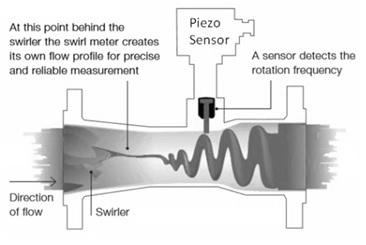
The operating principle is based on pressure variations caused by flow obstruction, similar to the vortex principle. In a swirl flowmeter, the fluid flows through fixed spiral vanes. This forces a spiral flow pattern throughout the entire pipe. The frequency of the fluid’s rotation is directly related to the flow rate. A sensor detects the speed of this rotation, and this information is then sent to the flowmeter’s electronic circuits.
Swirl flowmeters are capable of operating in demanding process and environmental conditions, offering an accuracy of around +/- 0.2%. For comparison, vortex flowmeters typically achieve an accuracy of approximately +/- 0.75% in liquids, gases, and steam.
Advertisement
Related Posts
Measurements
/Flow
This article compares swirl and vortex flowmeters, highlighting their operating principles, accuracy, and suitability for different applications.
Measurements
/Flow
Explore the working principle, advantages, and disadvantages of vortex flowmeters. Learn about their accuracy, range, and limitations.
Advertisement