
Terminology
/General
This article explains the concepts of Noise Spectral Density (N₀) and Carrier-to-Noise Spectral Density Ratio (C/N₀), detailing their definitions, formulas, and applications.
3 min read
Advertisement
Table of Contents
This article breaks down the differences between C/I (Carrier-to-Interference Ratio) and C/N (Carrier-to-Noise Ratio), two crucial measurements in RF communication. We’ll explore what each represents and how they’re measured.
C/N, or Carrier-to-Noise Ratio, is a measure of the power of a desired RF carrier signal relative to the background noise power within a channel. Essentially, it tells us how strong the intended signal is compared to the unwanted noise floor.
Here’s a breakdown:
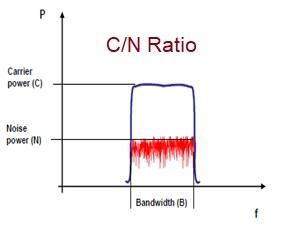
Let’s look at an example:
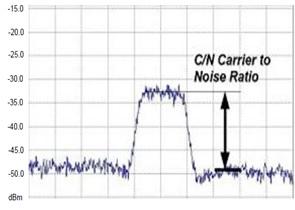
In this figure, a QPSK (Quadrature Phase-Shift Keying) signal is affected by ambient white noise. If the carrier power is measured at -32.5 dB and the noise power at -48 dB, then:
C/N ratio = (-32.5) - (-48) = 15.5 dB
This indicates a good signal strength relative to the noise.
C/I, or Carrier-to-Interference Ratio, measures the power of the desired RF carrier signal relative to the power of interfering signals within the channel. In simpler terms, it shows how strong the signal is compared to the other unwanted signals that might be present.
Key aspects of C/I:
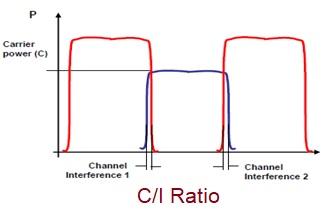
The core difference lies in what’s being compared to the carrier signal:
In essence, C/N focuses on the general noise floor, while C/I focuses on the impact of specific interfering signals. Both measurements are crucial for ensuring high-quality and reliable RF communication. They allow engineers to analyze and optimize system performance and channel quality.
Advertisement
Related Posts
Terminology
/General
This article explains the concepts of Noise Spectral Density (N₀) and Carrier-to-Noise Spectral Density Ratio (C/N₀), detailing their definitions, formulas, and applications.
Equipments
/RF
Explore the principles, operation, and applications of noise figure meters, including leading vendors and manufacturers.
Measurements
/General
Explore the difference between Bit Error Rate (BER) and Packet Error Rate (PER), key metrics for evaluating digital communication system performance.
Articles
/Wireless
An overview of WiFi testing, covering radio conformance, protocol conformance, and interoperability. Essential for WLAN device manufacturers and software developers.
Advertisement