
Equipments
/Electronics
Explore the fundamentals of Bit Error Rate (BER) and Bit Error Rate Testers. Learn about measurement techniques and available equipment.
3 min read
Advertisement
Table of Contents
This article explores the concepts of Bit Error Rate (BER) and Packet Error Rate (PER), two crucial metrics for evaluating the performance of digital communication systems, both wired and wireless. These systems often face challenges like noise, jitter, interference, and I/Q imbalances that can degrade signal quality. BER and PER help us quantify these degradations and assess the reliability of our data transmission.
BER is defined as the ratio of the number of received bits in error to the total number of bits transmitted during a specific test period. It’s a unitless measure, often expressed as a percentage. BER tester (BERT) is used to measure the Bit Error Rate. BER measurements are conducted over both short and long durations to evaluate the system’s stability and performance in the short-term and long-term before actual deployment.
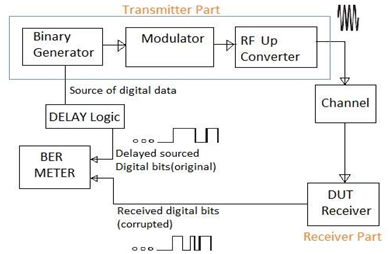
BER can be improved by using more robust modulation schemes and applying forward error correction (FEC) codes, such as Convolutional encoding and CTC. For instance, Binary Phase Shift Keying (BPSK) is more robust than Quadrature Phase Shift Keying (QPSK), which in turn is more robust than Quadrature Amplitude Modulation (QAM).
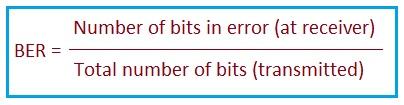
Let’s say we transmit a sequence of bits: [1 1 1 0 1 0 1 0 1 1 0]
If the received bits are [1 1 0 0 1 1 1 0 0 1 0], there are 3 errors.
Therefore:
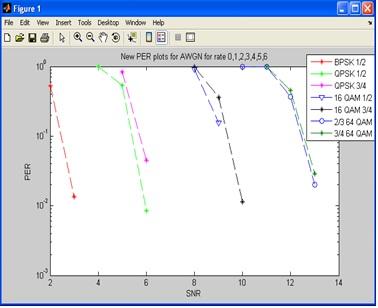
Packets or frames consist of multiple bytes (e.g., 8 bits per byte). For example, an Ethernet packet, as per IEEE 802.3, can carry up to 1518 bytes. Evaluating system performance at the packet level helps determine if errors occur at the bit level or the entire packet level. Packet Error Rate (PER) is defined as the ratio of the number of packets received in error to the total number of transmitted packets. A packet is considered to be in error if even a single bit within the packet is received incorrectly.
The figure below represents a plot of PER vs SNR (Signal-to-Noise Ratio) for a wireless system using various modulation schemes.
The following equation demonstrates the mathematical relationship between BER and PER, assuming an ideal communication system over a binary symmetric channel with uncorrelated noise:
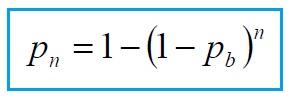
In the formula:
PER is determined by the BER and the number of bits within a packet’s data payload. It does not depend on data encoding methods or the transmit-receive process. The relationship can be expressed as:
$$ PER = 1 - (1 - BER)^n $$
In summary, the fundamental difference between BER and PER is that BER focuses on individual bits, while PER is concerned with entire packets. However, both are interrelated, as shown in the formula above, and they are both important measures for assessing the quality and reliability of digital communication systems.
Advertisement
Related Posts
Equipments
/Electronics
Explore the fundamentals of Bit Error Rate (BER) and Bit Error Rate Testers. Learn about measurement techniques and available equipment.
Equipments
/Networking
Overview of data communication test equipment (pattern generators, BER testers, TDR testers, protocol analyzers) and common tests like eye diagrams, noise margin, and BER measurements.
Terminology
/RF
Explore the differences between C/I (Carrier-to-Interference Ratio) and C/N (Carrier-to-Noise Ratio) in RF communication, their measurements, and importance.
Terminology
/General
This article explains the concepts of Noise Spectral Density (N₀) and Carrier-to-Noise Spectral Density Ratio (C/N₀), detailing their definitions, formulas, and applications.
Advertisement
Measurements
/Signal-Analysis
Explore EVM measurements for signal quality, focusing on subcarrier and symbol analysis in OFDM systems. Understand how each approach helps identify impairments.
Measurements
/RF
This article explores fading, its types, and the equipment used for simulation and analysis, including channel emulators from leading vendors.