
Articles
/General
Explore the definitions, differences, and relationship between stress and strain, two fundamental concepts in mechanics and materials science.
2 min read
Advertisement
Table of Contents
Strain gauges are essential tools for measuring mechanical strain, acting as passive transducers that convert displacement into a change in electrical resistance. These thin, wafer-like devices can be attached to various materials to measure applied strain, with the change in resistance being proportional to the applied force. This change is often measured using a Wheatstone bridge circuit.
The sensitivity of a strain gauge is characterized by its gauge factor. Simply put, the gauge factor represents the ratio of the relative change in resistance to the relative change in length (strain). It essentially tells us how much the resistance of the strain gauge changes for a given amount of deformation.
The gauge factor (K) can be expressed mathematically using the following equation:
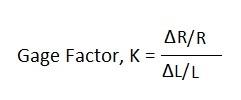
Where:
The equation shows us that the gauge factor (K) is essentially a ratio of two changes: the relative change in resistance (ΔR/R) and the relative change in length or strain (ΔL/L). A higher gauge factor means that for the same applied strain, the strain gauge will exhibit a greater change in resistance, making it more sensitive.
Strain, which is the deformation of the material, is often expressed as:
σ = ΔL/L
This equation signifies the change in length (ΔL) relative to the original length (L), defining the strain that the material has undergone.
In summary, the gauge factor is a crucial parameter in strain gauge applications, as it determines the sensitivity of the gauge and enables accurate measurement of strain in various mechanical and structural systems.
Advertisement
Related Posts
Articles
/General
Explore the definitions, differences, and relationship between stress and strain, two fundamental concepts in mechanics and materials science.
Measurements
/General
An overview of common pressure measurement devices and their typical pressure ranges, including manometers, Bourdon gauges, and ionization gauges.
Terminology
/General
Explore the fundamental differences between analog and digital transducers, their working principles, and examples.
Advertisement