
Measurements
/General
Understand the differences between oscilloscope bandwidth and rise time, their importance, and how they affect signal measurements.
2 min read
Advertisement
Table of Contents
The concept of the Bandwidth Time Product, often shortened to BT, is a fundamental idea in signal processing and communication systems. It essentially describes the relationship between a signal’s spectral width and its duration. Let’s break down what it means and why it’s important.
At its core, the Bandwidth Time Product (BT) is simply the multiplication of two key signal characteristics:
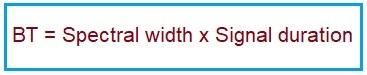
So, the formula for the Bandwidth Time Product is:
BT = BW * T
One of the key insights related to the BT is the often-observed inverse relationship between signal duration and spectral width. What does that mean? Generally, signals with:
The Bandwidth Time Product isn’t just an academic concept; it tells us how efficiently we’re using the available bandwidth for a given channel. Here’s why it matters:
Here’s an example of the Bandwidth Time Product.
In this example:
In Summary:
The Bandwidth Time Product (BT) is a critical concept for understanding how signals behave in terms of their frequency and time characteristics. It highlights the relationship between a signal’s width in the frequency domain and its length in the time domain, and ultimately reflects how well we are utilizing bandwidth for transmitting information.
Advertisement
Related Posts
Measurements
/General
Understand the differences between oscilloscope bandwidth and rise time, their importance, and how they affect signal measurements.
Articles
/General
This article compares Lifi and Bluetooth, detailing their speeds, applications and key differences to help users choose the right wireless technology.
Measurements
/RF
This article explores fading, its types, and the equipment used for simulation and analysis, including channel emulators from leading vendors.
Terminology
/General
A breakdown of common spectrum analyzer terms including RBW, VBW, Span, and Reference Level.
Advertisement
Terminology
/General
This article explains the concepts of Noise Spectral Density (N₀) and Carrier-to-Noise Spectral Density Ratio (C/N₀), detailing their definitions, formulas, and applications.
Equipments
/Wireless
Explore the fundamentals of RF network planning, optimization, and drive tests, including key terminologies, processes, and equipment used in cellular network development.