
Terminology
/General
Explore the fundamental differences between active and passive transducers, including their power requirements, output signals, and examples.
2 min read
Advertisement
Table of Contents
This article explores the differences between analog and digital transducers, two fundamental types of devices used to convert physical quantities into measurable signals.
An analog transducer is a device that transforms an input physical quantity (like temperature, pressure, or displacement) into an analog output signal. This analog output is characterized by its continuous variation over time. Think of it as a smoothly changing signal that mirrors the fluctuations of the input.
Common examples of analog transducers include:
A digital transducer, on the other hand, converts an input physical quantity into a digital output signal. This digital signal is represented by a series of discrete pulses, typically coded in binary form. Rather than a smooth curve, the output is a sequence of “on” and “off” states.
A prime example of a digital transducer is:
| Aspect | Analog Transducer | Digital Transducer |
|---|---|---|
| Output Signal | Analog output signal with continuous variation | Digital output signal with discrete pulses |
| Signal Representation | Smoothly changing signal | Binary coded sequence of “on” and “off” states |
| Input Conversion | Converts physical quantity to continuous signal | Converts physical quantity to discrete pulses |
| Examples | LVDT (Linear Variable Differential Transformer), Strain Gauge | Shaft Encoders |
| Applications | Measuring linear displacement, strain or deformation in materials | Measuring rotational position or speed of a shaft |
Transducers can be categorized in various ways, as illustrated below:
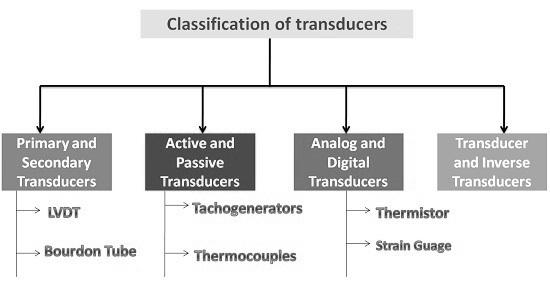
As seen above, transducers can be classified as:
Advertisement
Related Posts
Terminology
/General
Explore the fundamental differences between active and passive transducers, including their power requirements, output signals, and examples.
Terminology
/General
Understand the difference between primary and secondary transducers in measurement systems, their roles, and examples.
Articles
/General
This article compares analog and digital instruments, detailing their key features, differences, and examples.
Terminology
/General
Understand the difference between sensors and transducers, their roles in measurement, and how they often work together to convert energy forms.
Advertisement
Articles
/Electronics
Explore the differences between analog and digital sensors, their applications, and real-world examples.
Measurements
/General
An overview of common pressure measurement devices and their typical pressure ranges, including manometers, Bourdon gauges, and ionization gauges.