
Terminology
/General
Explore the fundamental differences between analog and digital transducers, their working principles, and examples.
3 min read
Advertisement
Table of Contents
Transducers are essential devices that convert energy from one form to another. They’re the workhorses behind countless measurement and control systems. A key way to categorize them is by whether they need an external power source to operate. This leads us to the distinction between active and passive transducers. Let’s explore the differences.
Active transducers are the independent types. They have the remarkable ability to generate their own electrical output when they sense a physical phenomenon. In other words, they don’t need any external power source to do their job.
Definition: An active transducer is a device that produces an electrical signal without requiring an external power supply.
Examples of Active Transducers:
In contrast, passive transducers require an external power source to operate. They work by modulating the external power in response to a physical change.
Definition: A passive transducer is a device that needs an external power source to produce an output signal.
Examples of Passive Transducers:
Here’s a helpful illustration showing how different transducers can be categorized:
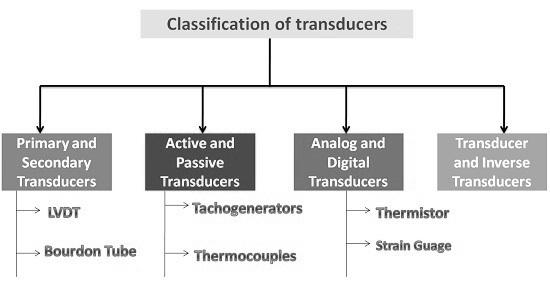 Figure 1: Transducer Types
As you can see, transducers can also be classified by other characteristics beyond active or passive, such as:
| Feature | Active Transducer | Passive Transducer |
|---|---|---|
| Power Source | No external source needed | Requires external source |
| Output | Generates electrical signal | Modulates external power |
| Examples | Piezoelectric, Thermocouple, Photovoltaic cell | Resistive, Capacitive, Inductive transducer |
Understanding the distinction between active and passive transducers is crucial for selecting the right device for a specific application. Active transducers are great for situations where you need self-powered operation, while passive transducers offer flexibility and a wide range of sensing capabilities when external power is readily available.
Advertisement
Related Posts
Terminology
/General
Explore the fundamental differences between analog and digital transducers, their working principles, and examples.
Terminology
/General
Understand the difference between primary and secondary transducers in measurement systems, their roles, and examples.
Terminology
/General
Explore the fundamental differences between active and passive sensors, including their working principles, applications, and advantages.
Terminology
/General
Understand the difference between sensors and transducers, their roles in measurement, and how they often work together to convert energy forms.
Advertisement