
Equipments
/RF
Learn about GTEM cells, including their construction, applications in EMC testing, and a list of popular manufacturers.
3 min read
Advertisement
Table of Contents
This article explores the methods and equipment used for measuring electric and magnetic fields. It also touches upon the significance of electromagnetic (EM) radiation and the importance of radiation measurements.
Electromagnetic waves are the backbone of modern communication, carrying information like voice, data, and images from source to destination. These waves travel at the speed of light, approximately 3 x 10^8^ m/s.
As depicted in Figure 1, an EM wave consists of two fundamental components: an electric field (E-field) and a magnetic field (H-field). These fields are perpendicular to each other and also perpendicular to the direction in which the wave travels. EM field strength is often measured as power per unit area, known as power density, with units of W/m², mW/cm², or µW/cm².
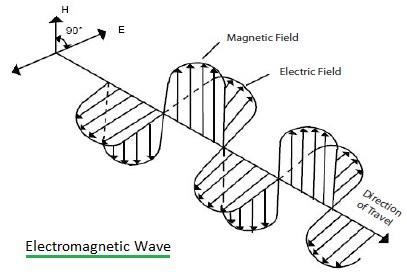
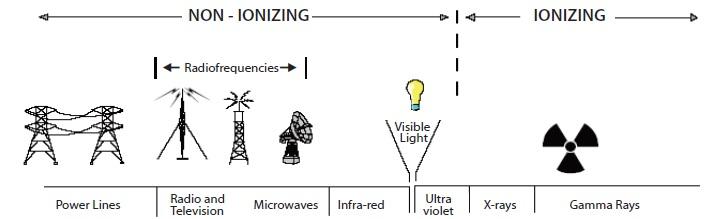
Figure 2 illustrates the diverse types of EM waves, each with varying frequency ranges and energy levels. EM radiation is generally categorized into ionizing and non-ionizing radiation. Ionizing radiation carries higher energy than its non-ionizing counterpart. In this article, we will focus on radiation emitted by mobile phones and cellular towers.
The EM waves used for these purposes are known as Radio Frequency (RF) waves. These typically fall within the 500 MHz to 2500 MHz range. Other frequency bands, like 3.5 GHz or 5 GHz, are used in wireless household applications like WLAN, Zigbee, Bluetooth, and HomeRF.
The output power of mobile phones and base stations must adhere to specified limits, determined by cellular system and RF interference experts. There are several compelling reasons for performing radiation measurements:
Electric field strength is measured in Volts per meter (V/m). Electric field meters or EMF meters are used to measure electric field strength in V/m, or body voltage in milli-Volts. Electric fields are found both outdoors and indoors. Outdoors, they are often generated by high-tension cables, which are usually grounded. Indoors, they are created by wall cables and various electrical appliances.
Measuring electric fields is crucial because it allows us to identify the presence of both low- and high-frequency fields, which can be harmful to human health.
Magnetic field strength is measured in Amperes per meter (A/m). It can also be measured in Tesla (T), milli Tesla (mT), nano Tesla (nT), or milliGauss (mG). Magnetic fields are particularly prevalent in densely populated areas with extensive low-power cabling. These fields can penetrate buildings and other structures, potentially affecting human health.
Magnetometers are used for measuring low magnetic fields, typically below 1mT, while Gaussmeters are used for measuring higher magnetic fields, above 1mT. It’s important to note that mitigating magnetic field interference can be a costly and complex task, underscoring the importance of accurate measurement.
Advertisement
Related Posts
Equipments
/RF
Learn about GTEM cells, including their construction, applications in EMC testing, and a list of popular manufacturers.
Measurements
/RF
Explore the crucial aspects of RF testing, including equipment, required skills, and key measurements for ensuring RF system performance and reliability.
Measurements
/Wireless
This article covers the fundamentals of GSM conformance testing, including physical layer, radio, and tools used for testing.
Terminology
/RF
Compare Coaxial, Triaxial and Twinaxial RF cables. Learn their structural differences, pros, cons and best use cases for high frequency harsh environments.
Advertisement
Terminology
/General
This article differentiates between EMC and EMI measurements, explaining their scope, testing methodologies, and relevant standards like CISPR 16 and MIL-STD-461.
Equipments
/Electronics
Overview of near-field probes, including their types (H-field and E-field), common applications in interference detection and shielding verification, and a list of manufacturers.