
Articles
/Wireless
An overview of WiFi testing, covering radio conformance, protocol conformance, and interoperability. Essential for WLAN device manufacturers and software developers.
4 min read
Advertisement
Table of Contents
This page provides an overview of Bluetooth testing, focusing on transmitter and receiver testing, including RF and baseband (PHY) conformance aspects. In this guide, we will understand Benefits of Bluetooth test tools and explore various bluetooth tools available from leading manufacturers with their respective features.
Bluetooth, a ubiquitous wireless technology, is used in applications ranging from Bluetooth headsets for mobile calls to data and file transfer. Several Bluetooth versions exist, including V1.0, V1.2, V2.0, V2.1, V3.0, and V4.0, each supporting different modulation schemes (e.g., GFSK, DQPSK, DPSK), packet formats, and data rates.
Bluetooth packets fall into two main categories: basic rate and enhanced data rate (EDR). A basic rate packet consists of an access code, header, and payload. EDR packets, on the other hand, comprise an access code, header, guard, sync, EDR payload, and trailer.
The Bluetooth standard defines different power classes for Bluetooth devices: class-1, class-2, and class-3. These classes dictate varying transmit power profiles, including power ranges and minimum/maximum power limits.
Generally, Bluetooth devices support two test modes to streamline mass production testing: loopback test mode and transmit test mode, illustrated below:
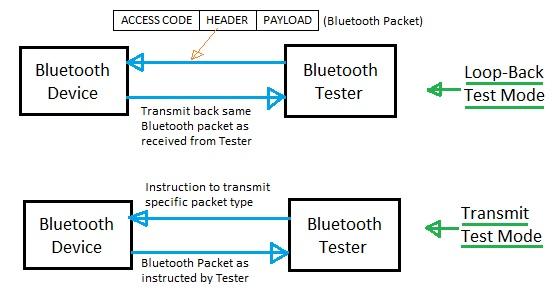
Loopback Test Mode: The Bluetooth device transmits the packet it receives from the Bluetooth tester, echoing the same payload. The tester then compares the transmitted payload with the original to determine a pass/fail result.
Transmit Test Mode: The Bluetooth device receives instructions from the tester regarding which packet to transmit. It transmits the designated packet, and the tester compares the transmission with the instructions provided.
Furthermore, Bluetooth devices must be evaluated against the protocol stack, depicted here:
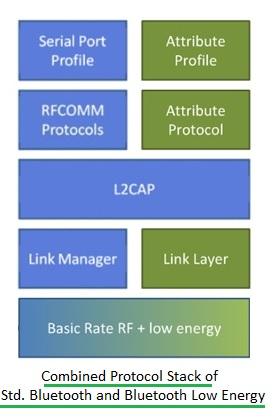
Two primary technology standards underpin Bluetooth device development: standard legacy Bluetooth (pre-V4.0) and Bluetooth Low Energy (BLE, version 4.0 and later). Various conformance test tools, as detailed below, are available for testing Bluetooth physical layer, RF layer, and upper-layer specifications.
A crucial aspect of Bluetooth RF testing is evaluating modulation characteristics and the RF channel frequency of the device. Standard Bluetooth devices utilize 79 channels from 2.4 GHz to 2.4835 GHz, spaced 1 MHz apart. BLE devices use 40 channels from 2.402 GHz to 2.480 GHz, including 3 advertising and 37 data channels.
The following tests are commonly performed during Bluetooth device transmitter testing:
The following tests are performed during Bluetooth device receiver testing:
The following table lists various Bluetooth test tools from reputable vendors and manufacturers, designed to meet conformance requirements for RF, PHYSICAL (baseband), and upper layers, including the MAC layer.
| Vendor or Manufacturer | Bluetooth Test Tool with Features |
|---|---|
| Anritsu | MT8852B, Bluetooth test set |
| Intertek | Bluetooth compatibility testing covering various test cases as per different versions |
| NTS (National Technical System Inc.) | Bluetooth Testing and Certification Provider |
| Litepoint | IQ2010, IQxel-80, IQxel-160 |
| Rohde & Schwarz | R&S® CBT/CBT32 Bluetooth testing tool for RF and audio measurements |
| Keysight Technologies | The following Keysight tools are useful for Bluetooth device testing: |
| • N7606B-Bluetooth signal studio | |
| • N9081A,W9081A-Bluetooth measurement applications | |
| • N4010A-Bluetooth headset testing tool | |
| • T1111S,T1212S-Bluetooth protocol conformance test system | |
| • E1852B-Bluetooth test set |
Following are some of the major advantages of bluetooth test equipments.
Bluetooth test tools are essential for ensuring the functionality, reliability, and efficiency of Bluetooth enabled devices. By enabling accurate performance measurement, compliance verification and troubleshooting, these tools help manufacturers and developers optimize connectivity, reduce power consumption, and enhance user experience. As Bluetooth technology continues to evolve, these test tools remain critical for maintaining high-quality wireless communication across various applications.
Advertisement
Related Posts
Articles
/Wireless
An overview of WiFi testing, covering radio conformance, protocol conformance, and interoperability. Essential for WLAN device manufacturers and software developers.
Companies
/Electronics
An overview of Keysight Technologies, a prominent test and measurement company, its history, products, and resources.
Measurements
/Wireless
This article explores 5G UE conformance testing, covering RF, RRM, and OTA tests, and the equipment used to ensure devices meet 3GPP standards.
Equipments
/Wireless
An overview of BLE data loggers, highlighting features and benefits, with a focus on ONSET data loggers and example models for temperature and humidity.
Advertisement
Equipments
/Wireless
A comparison of the Litepoint IQxel-M and Keysight 33522b solutions for Zigbee testing, detailing their hardware and capabilities.
Articles
/General
This article compares Lifi and Bluetooth, detailing their speeds, applications and key differences to help users choose the right wireless technology.