
Measurements
/RF
Explore the crucial aspects of RF testing, including equipment, required skills, and key measurements for ensuring RF system performance and reliability.
5 min read
Advertisement
Table of Contents
This page covers antenna range basics and mentions antenna range types, which include near field and far field antenna test ranges. It also describes their functions, applications and benefits. As we know, an antenna is a device used as an electromagnetic (EM) transformer. It is used to send and receive EM Waves to/from the air.
Following are the parameters that need to be evaluated for an RF antenna:
An antenna test range is required to test and measure the above-mentioned antenna parameters. The selection of an antenna test range depends on the following parameters:
Perfect antenna measurement depends on monitoring and controlling the following parameters, in addition to selecting the right antenna range as per need:
An antenna test range used for radiation pattern measurement consists of the following subsystems:
Following are the types of antenna ranges:
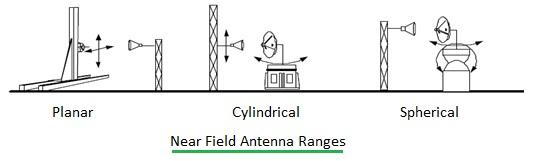
The figure-1 depicts a near-field antenna range. The distance or range from the antenna up to 2*D^2/λ is known as the near-field distance. Here, D is the aperture diameter of the AUT (Antenna Under Test), and λ is the operating wavelength.
These antenna test ranges are usually used to test antennas indoors in a small space. It uses a small RF probe on one side and the AUT on the other side. The distance or separation between the two is about 4 to 10 wavelengths long.
Either the RF probe is scanned and the AUT is kept fixed, or the AUT is moved and the RF probe is kept fixed during measurement. During the measurement, both amplitude and phase information are collected at discrete points as determined.
Based on the scanning method, there are three types of near-field methods: planar, cylindrical, and spherical.
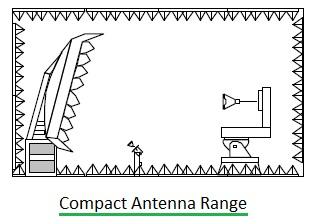
The figure-2 depicts a compact antenna test range. This is a supplement to the traditional far-field antenna range. The testing carried out in the far-field can also be done in a compact antenna test range.
The advantage of such a test range is that testing is done in an indoor anechoic chamber. This avoids all weather and security-related concerns while testing. One can also avoid interference generated by other sources with the use of a shielding chamber. This facility is very convenient for R & D engineers due to its compact size.
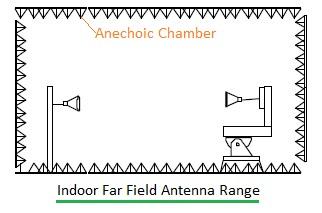
The figure-3 depicts an indoor far-field antenna test range. The distance or range from the antenna above 2*D^2/λ is known as the far-field range or distance. An anechoic chamber is used here.
There are three main entities in this antenna range: a receiver front end, a signal source, and a positioner. The Antenna Under Test (AUT) is located on the positioner. Polarization control is available with the source antenna.
A control room is connected to both ends of the antenna range using cables or links. As all the equipment is located indoors and an anechoic chamber is used, the test facility is known as an indoor far-field range.
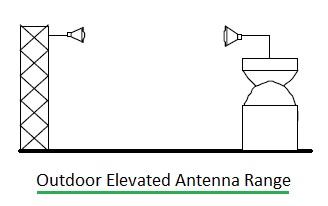
The figure-4 depicts an outdoor far-field antenna range. The test system consists of a test antenna with a receiver front end and positioner, a source antenna, and an outdoor enclosure.
The outdoor enclosure protects the setup from weather and temperature effects. The receiver portion is remotely controlled using a control console. Both sides are fixed on a tower or supporting structure opposite each other.
An antenna range is a controlled testing environment used to measure and evaluate the performance of antennas. Following are some of the advantages of antenna range types.
Antenna range testing is crucial for ensuring the efficiency, reliability, and regulatory compliance of antenna systems. By providing precise performance measurements and reducing interference, antenna ranges contribute to the development of high quality antennas for modern communication networks. As technology evolves, these testing facilities will continue to be instrumental in enhancing connectivity and innovation across various industries.
Advertisement
Related Posts
Measurements
/RF
Explore the crucial aspects of RF testing, including equipment, required skills, and key measurements for ensuring RF system performance and reliability.
Equipments
/RF
Learn about GTEM cells, including their construction, applications in EMC testing, and a list of popular manufacturers.
Measurements
/RF
A guide to RF coupler testing, covering key parameters like coupling, directivity, insertion loss, and test setups. Learn how to measure these specifications.
Equipments
/Electronics
Overview of near-field probes, including their types (H-field and E-field), common applications in interference detection and shielding verification, and a list of manufacturers.
Advertisement
Measurements
/RF
This article compares SISO and MIMO testing, covering setups, common RF compliance tests for transmitters and receivers, and key differences.
Measurements
/RF
This article explores the various measurements performed on radar systems, including range, PRI, PRF, duty cycle, pulse width, power, antenna gain, EIRP, and more.