
Articles
/Networking
This article clarifies the roles of modems and routers, explaining how they enable internet connectivity and comparing their functions.
4 min read
Advertisement
Table of Contents
This article explores the distinctions between IoT (Internet of Things), IoE (Internet of Everything), and M2M (Machine to Machine) communication. While these terms are often used interchangeably, they represent different scopes and applications within the interconnected world of technology.
The Internet of Things (IoT) refers to a network of physical “things” or devices interconnected with each other. These devices are equipped with:
IoT devices rely on existing network technologies, adding a framework to create their own networks. This means IoT cannot exist independently but depends on other technologies.
M2M communication enables bi-directional data transfer between machines, or between machines and management systems. It’s also sometimes referred to as ‘mobile to machine’ or ‘machine to mobile’. The key idea is networking machines so they can freely exchange data without human interaction.
M2M communication typically works in two ways:
In M2M, data from machines can be automatically uploaded to a computer system without human involvement, enabling remote monitoring and maintenance.
An M2M device typically includes a sensor or tag and a communication module.
The Internet of Everything (IoE) expands upon the IoT infrastructure. It aims to add intelligence to the IoT network, facilitating convergence, visibility, and orchestration across previously separate systems. This allows individual systems to function as a cohesive whole.
The IoE encompasses the following subsystems:
Consider an air traffic network. In the IoE context, this would include not just planes and paths, but also ticket machines, customers, staff, and environmental conditions.
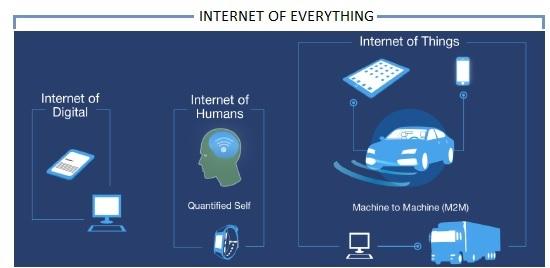
IoE is built upon the foundation of IoT, so they share similar frameworks and protocols. The primary difference is that IoE incorporates additional features to provide greater intelligence to network devices.
In essence: IoE = IoD + IoH + IoT + M2M
| Specifications | IoT | M2M |
|---|---|---|
| Architecture | Hybrid of distributed and centralized | Centralized |
| Topology | Star, Mesh, Cluster Tree | Star |
| Network Tier | Hierarchical | Flat |
| Data Rate | 10 to 300 Kbps | 100 to 1000 Kbps |
| Security | Strong | Minimal to strong |
| Range | 100m to 20 Km | 100m to 5 Km |
| End to End Latency | Higher | Lower |
| Downstream/Upstream | 50/50 | 80/20 |
| Technology | IoT platforms | Cellular |
| Battery Power | 2 to 15 years | 1 Day |
| Flow Direction | Some to data center, some at network edge | All traffic to data center |
| Vendors | Several to many | One |
While IoT, IoE, and M2M are related concepts, they each represent distinct layers of interconnectedness. IoT focuses on connecting physical devices, M2M enables machine-to-machine communication, and IoE integrates these elements along with human and digital aspects to create intelligent, cohesive systems. Understanding their differences is crucial for leveraging these technologies effectively.
Advertisement
Related Posts
Articles
/Networking
This article clarifies the roles of modems and routers, explaining how they enable internet connectivity and comparing their functions.
Articles
/General
This article compares Lifi and Bluetooth, detailing their speeds, applications and key differences to help users choose the right wireless technology.
Articles
/Electronics
A comparison of VME and PXI buses, highlighting their differences in features, performance, and applications.
Articles
/General
This article compares Lifi and Ethernet, detailing their speeds, applications and key differences to help users choose the right internet technology.
Advertisement
Equipments
/Wireless
An overview of BLE data loggers, highlighting features and benefits, with a focus on ONSET data loggers and example models for temperature and humidity.
Articles
/Wireless
Explore the crucial testing types for IoT devices, covering reliability, RF, protocol, regulatory, and interoperability aspects.