
Articles
/RF
This article compares spectrum analyzers and network analyzers, explaining their distinct purposes, accuracy, and measurement techniques.
2 min read
Advertisement
Table of Contents
This article explores the advantages and disadvantages of using a spectrum analyzer, a crucial tool for analyzing signals in the frequency domain.
Unlike oscilloscopes, which display signals over time, spectrum analyzers reveal the frequency components of a signal. They are essential for measuring power levels, identifying spurious signals, harmonics, sidebands, and phase noise. These devices measure RF and microwave signals in real time.
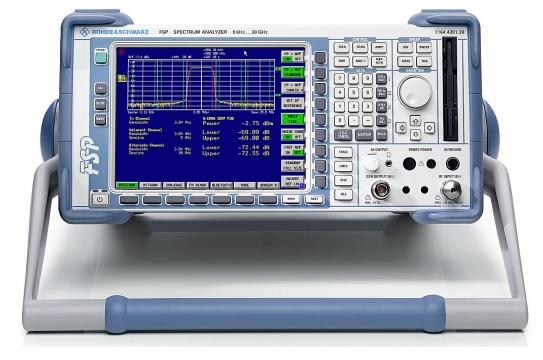 Figure 1: A typical RF spectrum analyzer from R&S, capable of measurements up to 30 GHz.
There are several types of spectrum analyzers, including swept, FFT (Fast Fourier Transform), real-time (RTSA), and audio spectrum analyzers.
Modern Real-Time Spectrum Analyzers (RTSA) combine the best features of swept and FFT analyzers. By leveraging both superheterodyne and FFT concepts, along with large memory capacities, they overcome the limitations of traditional spectrum analyzer types. This combination allows RTSAs to provide comprehensive analysis capabilities within a single device.
Advertisement
Related Posts
Articles
/RF
This article compares spectrum analyzers and network analyzers, explaining their distinct purposes, accuracy, and measurement techniques.
Equipments
/RF
A comparative analysis of spectrum analyzers from Keysight, Tektronix, and Rigol, highlighting key specifications and features for RF applications.
Companies
/Electronics
An overview of Keysight Technologies, a prominent test and measurement company, its history, products, and resources.
App-Notes
/RF
This article explores the Keysight 89600 VSA, its features, and how it works for RF signal analysis, including modulation and standards support.
Advertisement